Understand any enterprise platform in minutes, not the first afternoon of a new integration.
Point Scout at a platform's OpenAPI spec and docs. Get a cited, browsable integration blueprint and a real threaded chat assistant, in a local web app. It also ships an equally capable CLI and MCP server, so any MCP-speaking coding agent (Claude Code, Cursor, Codex, Gemini CLI, and more) pulls the same grounded understanding straight into its own context.
The problem
Coding agents guess at API shapes. Scout gives them ground truth instead.
You open a platform's docs to build an integration. Forty tabs in, you still don't know how auth actually works, what the core objects are, or which of six similarly-named endpoints does what you need. You paste a docs URL into your coding agent and ask it to wire up the integration. It writes confident code against an endpoint that doesn't exist, because it's pattern-matching against every payments API it saw in training, not reading this platform's actual docs.
That gap, between what a coding agent assumes and what a platform's docs actually say, is where integrations break. Scout closes it. It reads the OpenAPI spec as ground truth for what the API can do, crawls the docs as ground truth for how it's meant to be used, and cross-checks one against the other. When something isn't evidenced in either, it says so instead of inventing it.
Who it's for
Built for the people who live in third-party APIs
Anyone integrating with a platform regularly, not just once, plus the people who manage and greenlight that work.
Forward Deployed Engineers
Standing up a bespoke integration on-site, fast. Get a grounded understanding of the customer's platform before you write a line of code.
Integration & platform engineers
Third-party APIs are the job, not a side quest. Keep a living, cited understanding of every platform your team integrates with, refreshed as docs change.
Solutions architects
Evaluate a vendor's real API surface before a build/buy decision, not just their marketing docs, with an honest read on what's actually supported.
Engineering managers & team leads
Onboard a new hire onto a platform the team already knows, without handing them a stale wiki page and a Slack thread to dig through.
CTOs & technical decision-makers
A fast, honest read on whether a platform's API can actually do what the vendor claims, before your team commits to it.
DevEx & platform teams
Give every engineer on the team the same grounded, cited platform knowledge instead of scattered tribal notes and outdated internal wikis.
What you get
One import, a complete integration picture
Everything below runs identically on the web app, the CLI, and MCP - same functions, three surfaces.
A full, cited understanding
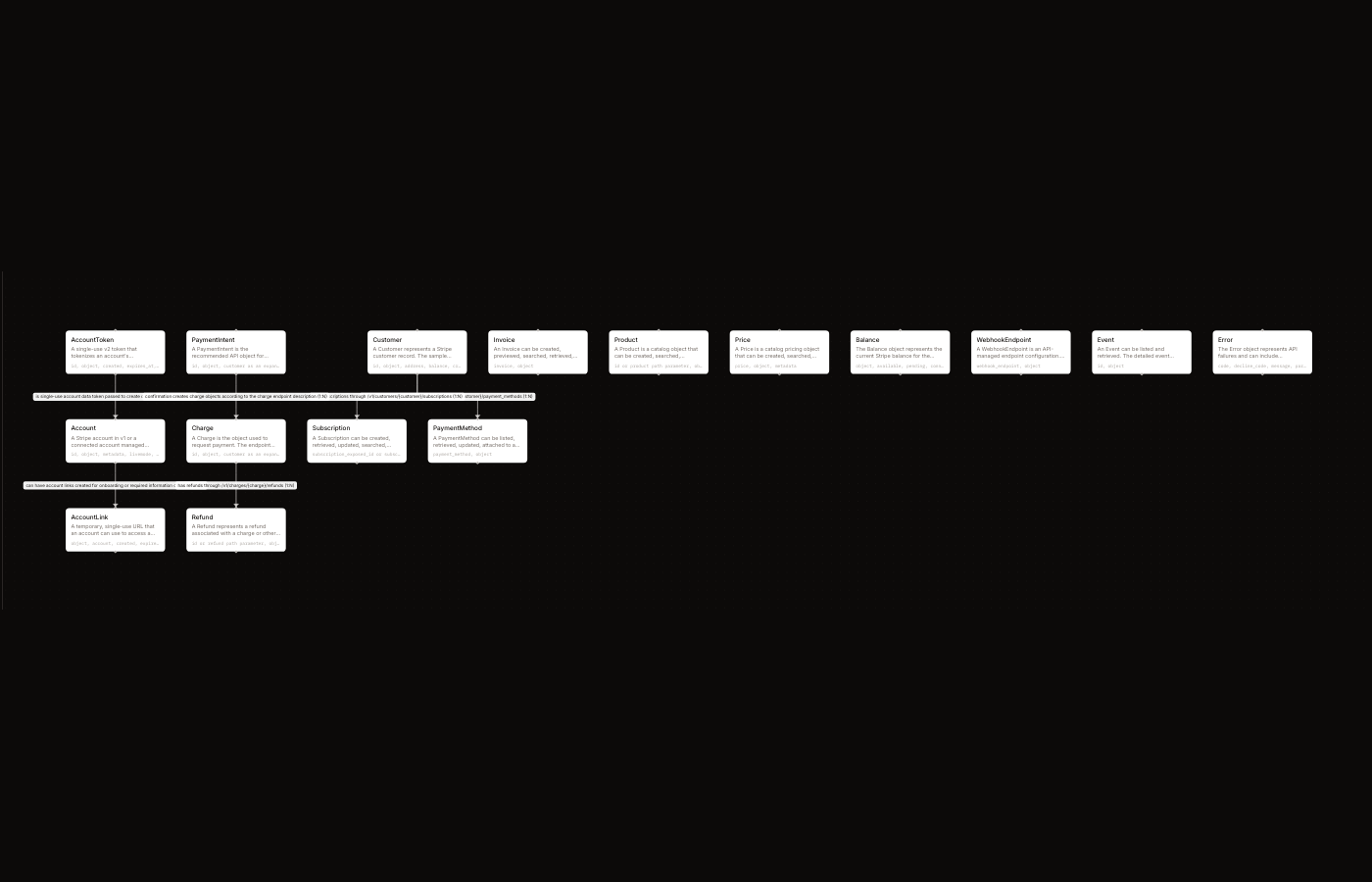
Architecture, auth flow, data model, entity relationships as a real diagram, common workflows, pitfalls, and security observations - generated from the spec and docs you pointed it at, not a generic template.
Never a fabricated citation
Every answer is tagged with where it came from: a doc excerpt with a real similarity score, a live web result with a URL, or the model's own knowledge, flagged unverified.
Real, syntax-checked starter code
The auth handshake plus one working call - never a stub dressed up as working code. Unsupported auth schemes get an honest, labeled stub with a stated reason instead.
Real threads, not one chat box
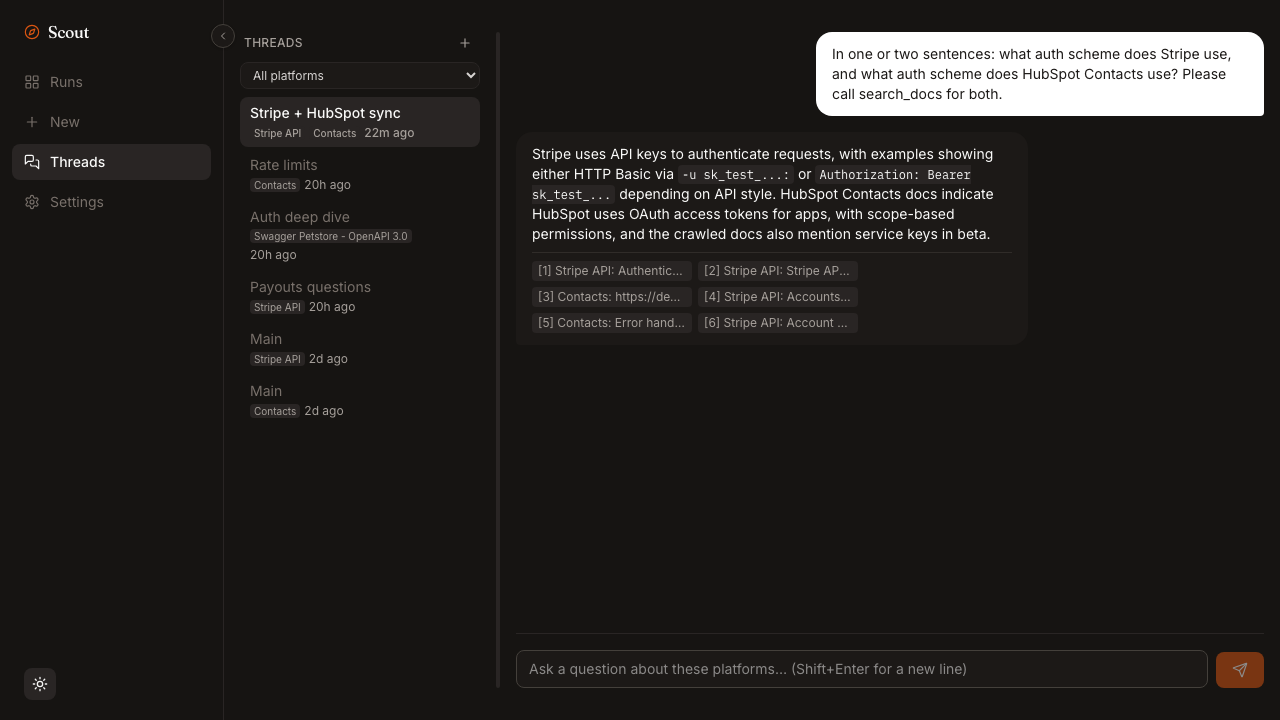
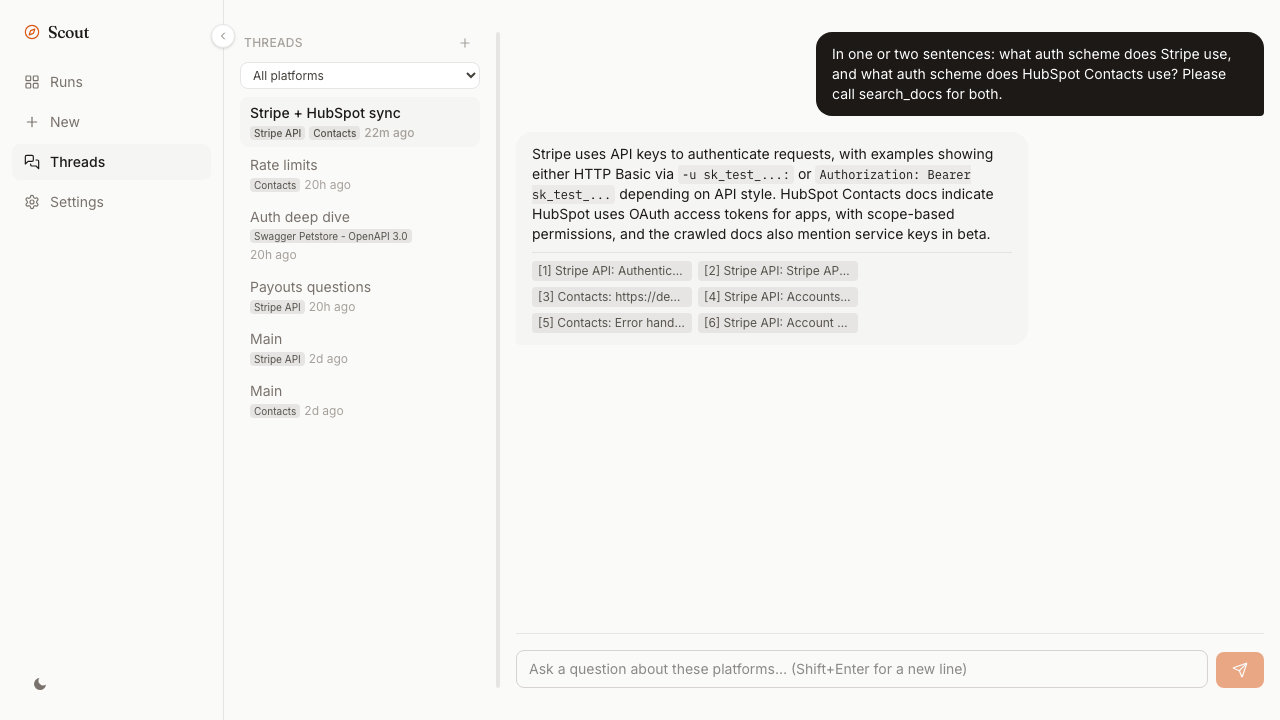
Claude/ChatGPT-style: multiple named conversations per platform, or grounded across several platforms at once, each citation tagged with which one it came from.
A paste-ready IDE handoff
Task, auth, starter code, .env.example, and real pitfalls in one Markdown brief - optionally folding an LLM-distilled summary of a chat thread in too.
MCP for your coding agent
Twelve tools give any MCP-speaking coding agent (Claude Code, Cursor, Codex CLI, Gemini CLI, and more) the exact same grounded understanding, mid-session, no copy-pasting docs into a chat window.
See it in action
A real interface, not a proof of concept
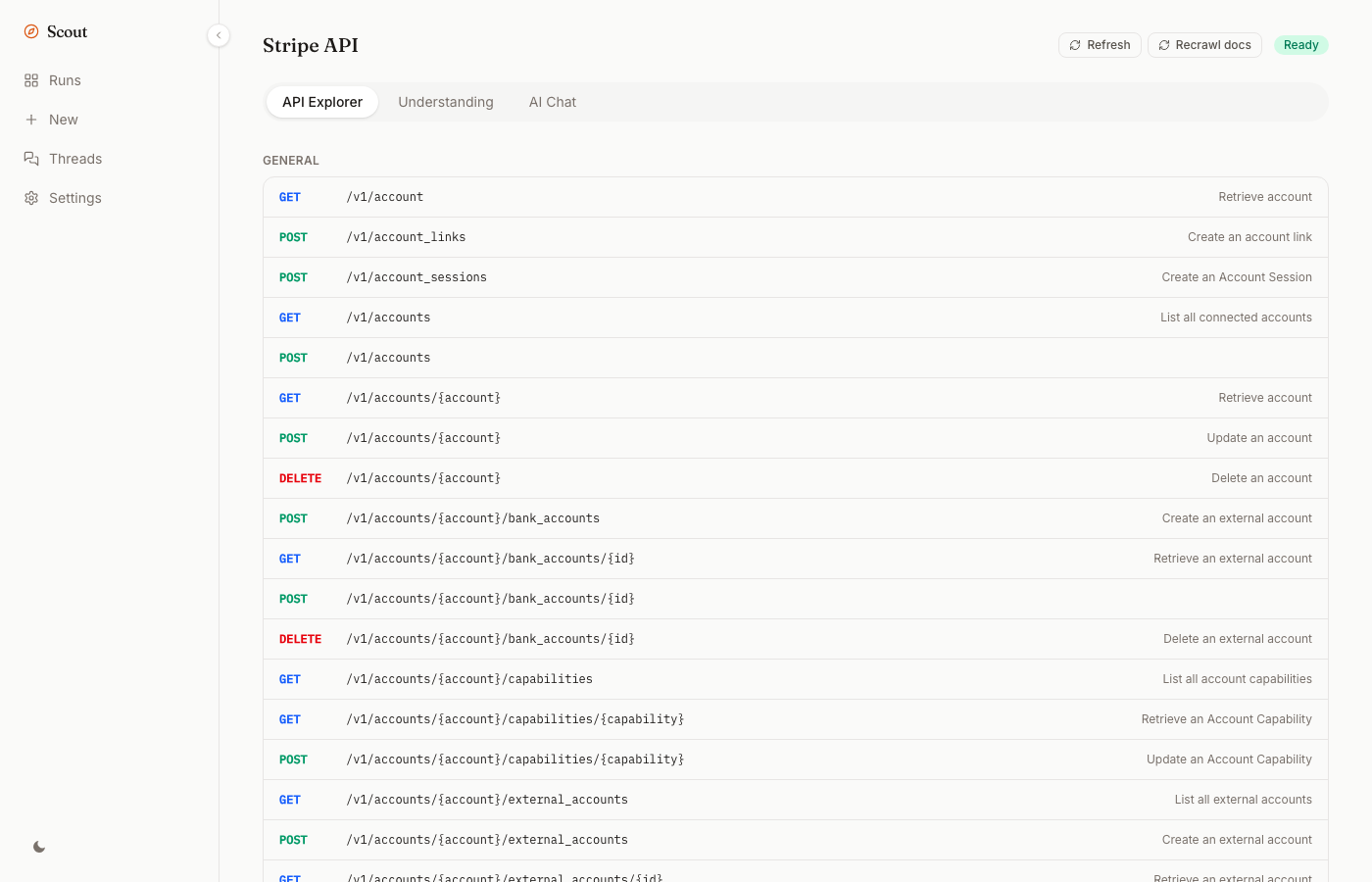
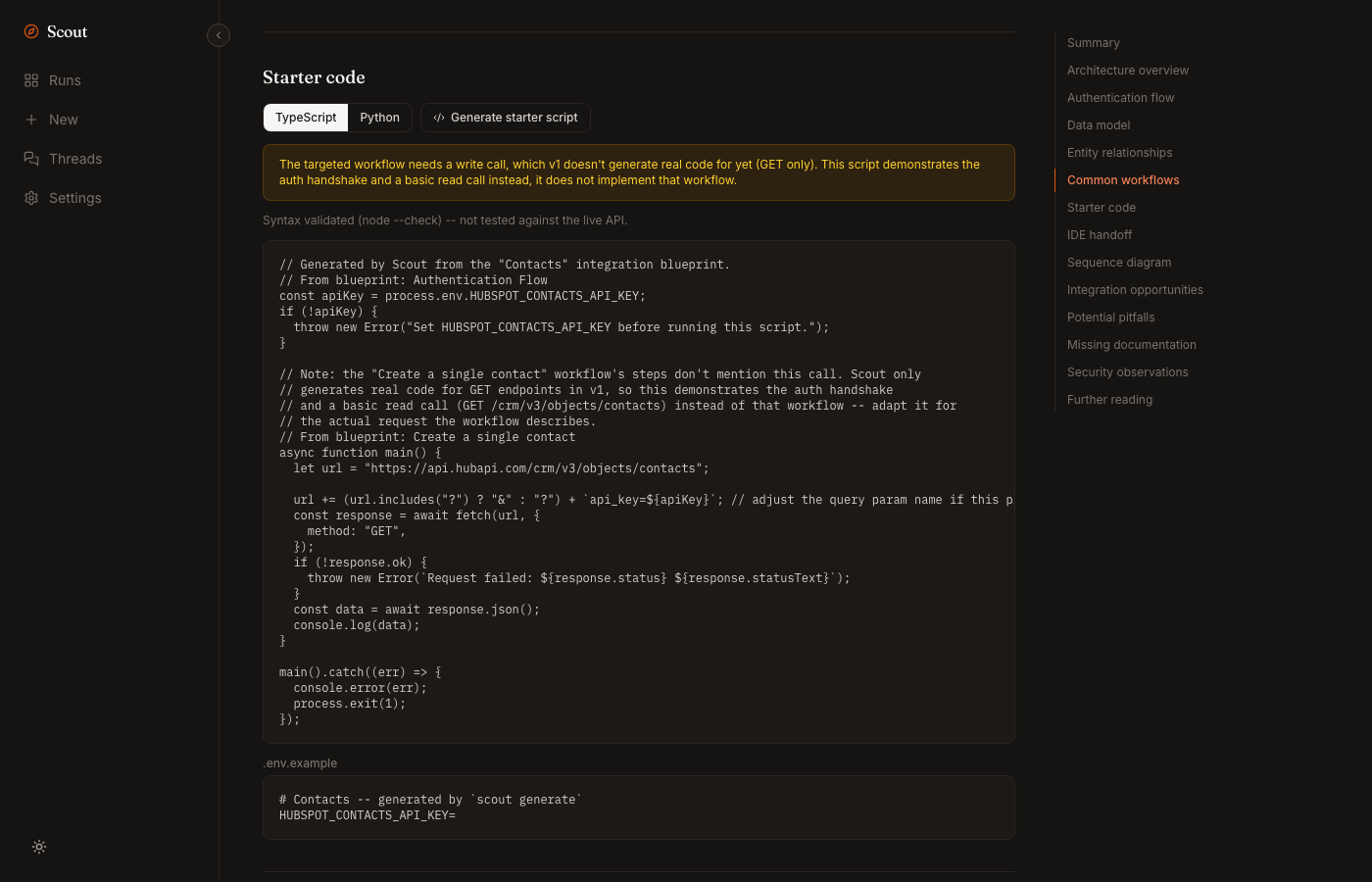
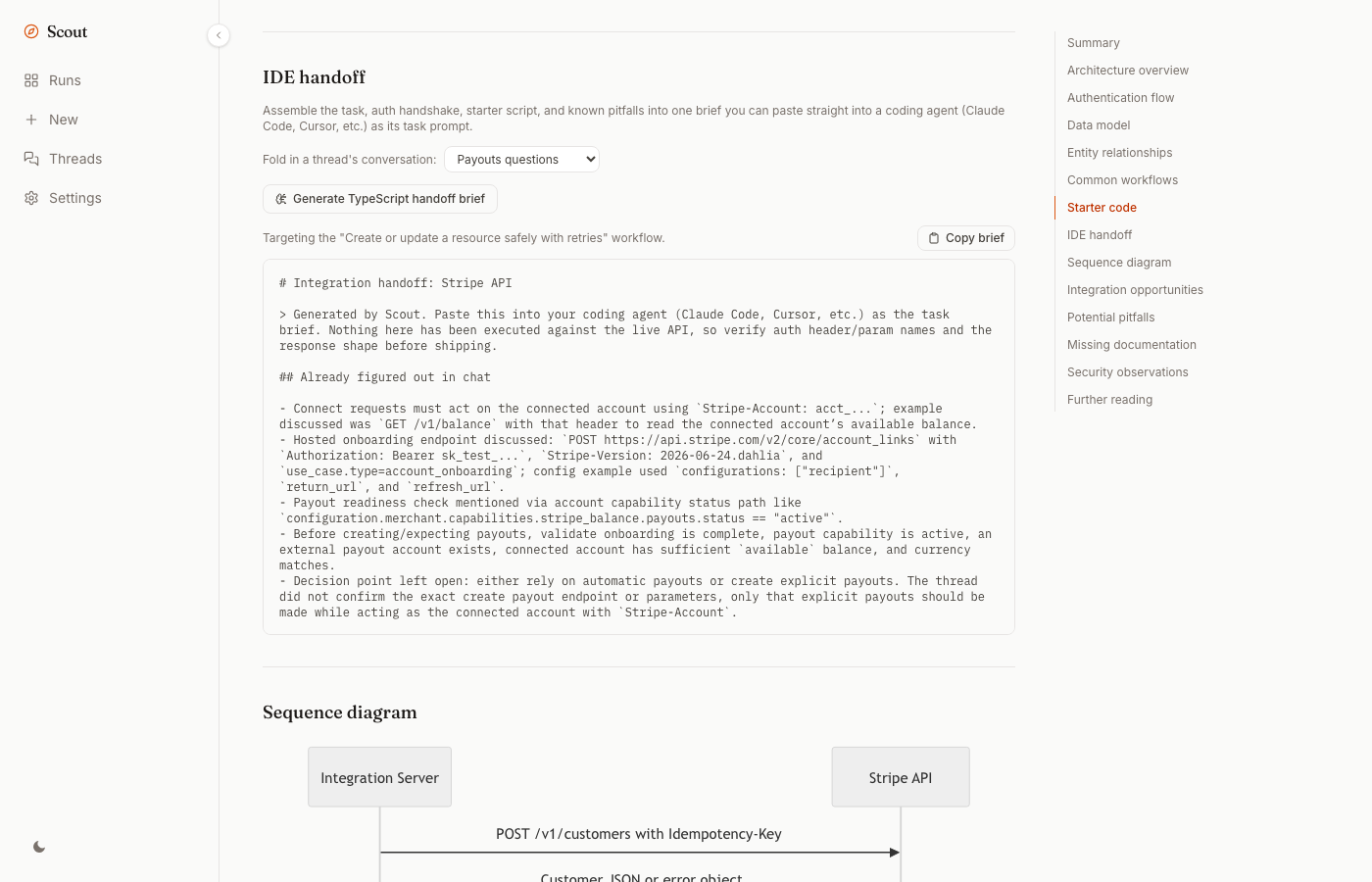
Three surfaces, one pipeline
Web app, CLI, or MCP - never a separate implementation
Every tool here is a thin wrapper around the same agent/store functions, so there's nothing to fall out of sync.
scout serve
Opens at http://127.0.0.1:4207, no login, nothing leaves your machine.
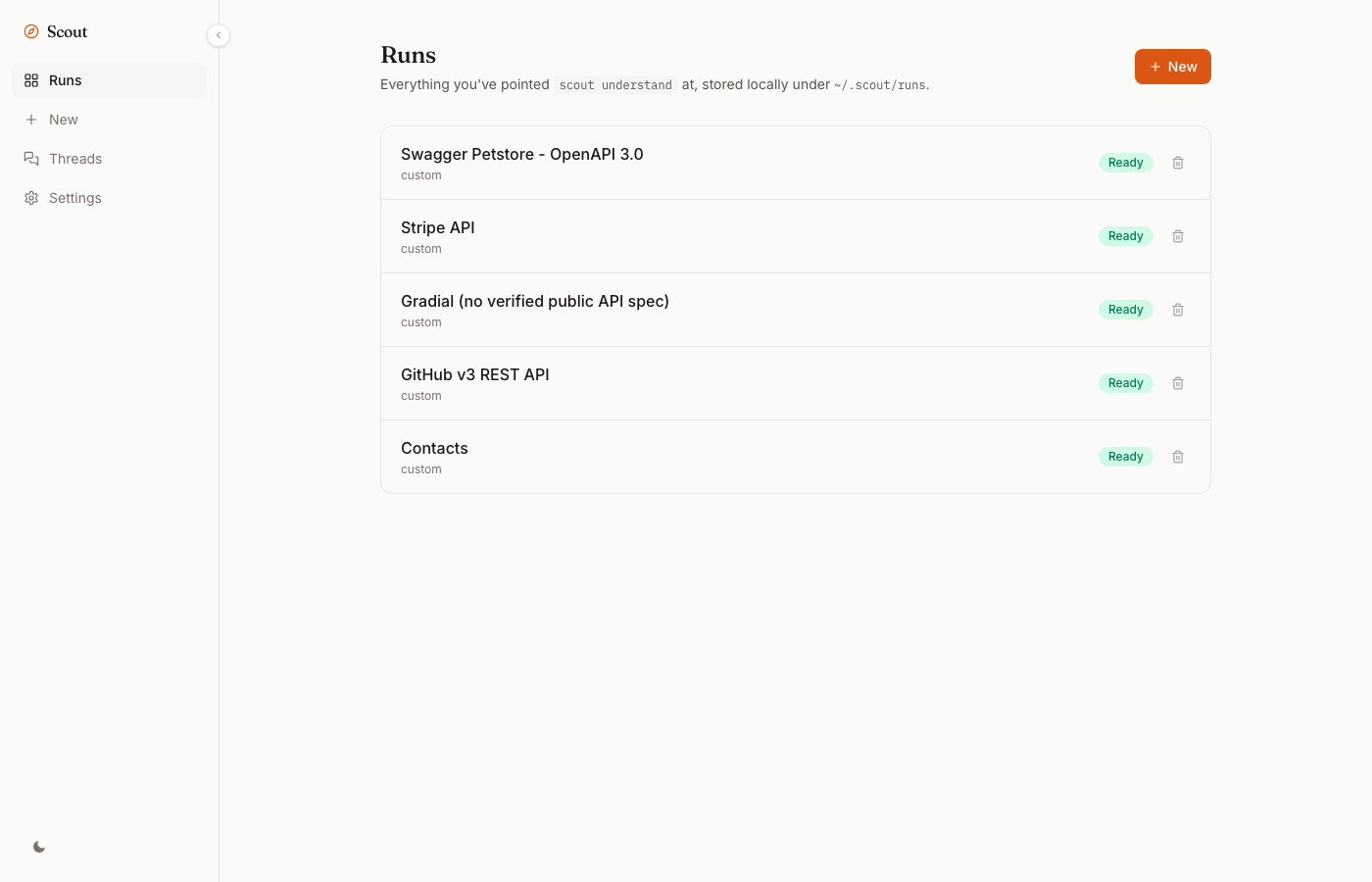
- Runs, New, Threads, Settings, sidebar collapsible to icon-only
- API Explorer with every endpoint, method-color-coded
- Understanding page with table of contents + entity diagram
scout <command>
Every capability the web app has, scriptable from a shell.
understand,chat,generate,handoffdiff,refresh,watch,exportdocs add/list/rm,connectors,config
scout mcp
A standard stdio MCP server - works with any MCP client, 12 tools, added once.
- Claude Code, Claude Desktop, Cursor
- Codex CLI, Gemini CLI, and more
- Same understanding, pulled mid-task, no copy-paste
Real examples
Verified end-to-end against real, public specs
| Platform | Command | What Scout found |
|---|---|---|
| Stripe | scout understand https://raw.githubusercontent.com/stripe/openapi/master/openapi/spec3.json --docs https://docs.stripe.com |
Auth is HTTP Basic, not Bearer - real templates don't cover it yet, so scout generate correctly stubs instead of guessing. |
| HubSpot (Contacts) | scout understand <hubspot-openapi-url> --docs https://developers.hubspot.com/docs/api/crm/contacts |
Real, syntax-validated TypeScript for the api_key_query auth scheme, plus 25+ real pitfalls pulled straight from the docs. |
| GitHub (REST API) | scout understand <github-openapi-url> --docs https://docs.github.com/en/rest |
Correctly identified none-scheme public endpoints vs. token-gated ones, and generated an honest stub rather than assuming a default. |
More platforms, full transcripts, and the honesty behavior explained: read the examples in the docs →
How it compares
Not a chat wrapper, not a spec viewer
Where Scout sits next to the tools you'd otherwise reach for.
| Capability | Scout | Generic LLM chat | Swagger / OpenAPI viewer | Reading docs manually |
|---|---|---|---|---|
| Cited, verifiable answers | Yes | No | N/A | You verify |
| Cross-checks spec against real docs | Yes | No | No | Manually |
| Real, syntax-checked starter code | Yes | Unverified | No | No |
| MCP tool for coding agents | Yes | No | No | No |
| Detects when docs drift | Yes | No | No | No |
| Local-first, no telemetry | Yes | Cloud | Depends on host | Yes |
| Cost beyond your own API key | None | Subscription | None | None |
"Generic LLM chat" means ChatGPT/Claude/etc. with a docs URL pasted in, no tool access to re-search or cross-check.
Two minutes to a grounded blueprint
From install to a cited chat, in one sitting
Install & add a provider
Node 22+, no account, no telemetry. One LLM provider for synthesis and chat.
npm install -g @dotapk7/scoutcli
# or: anthropic, azure-openai, openrouter, openai-compatible (Ollama, LM Studio, vLLM)
scout config llm add openai --api-key sk-...
Point it at a platform
The OpenAPI/Swagger spec (URL or file), and optionally doc pages to crawl for grounded chat.
scout understand https://petstore3.swagger.io/api/v3/openapi.json --docs https://example.com/docs
Open the web app
Runs, New, Threads, API Explorer, Settings - everything lives at 127.0.0.1:4207.
scout serve
Wire it into your coding agent
One command, and your coding agent pulls real, cited platform knowledge mid-task instead of guessing.
claude mcp add scout -- scout mcp
Questions
Everything people ask before trying it
Does Scout send my data anywhere?
No hosted backend, no accounts, no telemetry. The only network calls are the ones you configure: the platform's spec/docs URLs, your chosen LLM provider, and your chosen search provider (if enabled). Everything else stays under ~/.scout/.
Why isn't this just ChatGPT with the docs pasted in?
A generic chat model has no way to tell "this is definitely true" from "this sounds plausible." Scout cross-checks the OpenAPI spec against crawled docs and is instructed to say "missing documentation" instead of guessing, with real tool access to re-search mid-conversation.
Why isn't this Swagger UI?
Swagger UI renders a spec. It doesn't crawl docs, synthesize an architecture overview, answer questions, generate starter code, or expose an MCP tool. Scout's primary output is an understanding - a spec viewer is a side effect of already having imported the endpoints.
Does this cost money to run?
Scout itself is free and open source. You pay whatever your configured LLM/search provider charges. scout understand prints a size estimate before starting, and local models via Ollama/LM Studio work for zero marginal cost.
Does it work with local/open-source models?
Yes - anything speaking the OpenAI chat-completions wire protocol works via scout config llm add openai-compatible --base-url <endpoint>: Ollama, LM Studio, vLLM, or a hosted OpenRouter model.
What happens to my API keys?
Stored in ~/.scout/config.json on your machine, never printed back by scout config llm list, never transmitted anywhere except directly to the provider you configured.
Can multiple people on my team share runs?
Not today - LocalFileStore is single-machine by design. A dormant hosted mode (apps/api, apps/workers, Postgres-backed, multi-user) exists in the repo for anyone who wants a shared deployment.
What if the platform doesn't have a public OpenAPI spec?
Scout needs one - that's the ground-truth contract the honesty model is built on. Many platforms without an advertised spec still have one (check /openapi.json, /swagger.json). If a platform genuinely has none, Scout isn't the right tool yet.
Is the generated code safe to run against a live API?
It's syntax-checked, not execution-tested. "Syntax validated" means it parses, not that the call succeeds or matches your account's permissions. Treat it as a correct starting point, not a finished integration.
What OpenAPI/Swagger versions does Scout understand?
OpenAPI 3.0 and 3.1, plus Swagger 2.0, from either a URL or a local file. scout understand detects the kind automatically, or you can pass --kind explicitly if detection guesses wrong.
Does Scout run on Windows?
Yes, anywhere Node 22+ runs: the CLI and the local web app both work on Windows, macOS, and Linux. If you'd rather skip installing Node entirely, the Docker path (docker compose up) works identically everywhere.
How do I know if a platform's docs have changed since I imported them?
scout diff <slug> shows exactly what changed in a run's understanding since its last refresh. scout watch <slug> polls the run's doc URLs on an interval and refreshes automatically, archiving the previous snapshot so the next diff has something to compare against.
Can I use more than one LLM provider at once?
Yes. Add as many scout config llm add entries as you want, each scoped to chat, embedding, or both via --roles, with a --priority for fallback order within a role. This is also how you pair Anthropic (chat only, no embeddings API) with an OpenAI/Azure/compatible entry for embeddings.
What auth schemes does the code generator actually support?
Real, syntax-checked templates for an API key in a header, a Bearer token, and an API key as a query param. OAuth2, HTTP Basic, and write-only workflows get an honest, clearly labeled stub with a stated reason instead of fabricated code - see the auth-scheme coverage table in the docs.
What if my platform isn't in the connector list?
Connectors are optional. A connector is just a JSON preset mapping a slug to a suggested docs URL and default auth scheme, saving you a search for where the spec lives - it doesn't gate anything. scout understand works against any valid OpenAPI/Swagger spec, connector or not, and you can drop your own preset into ~/.scout/connectors/.
How do I uninstall Scout or remove a run?
scout rm <slug> --yes deletes one run and everything under it. To remove Scout entirely: npm uninstall -g @dotapk7/scoutcli, then delete ~/.scout/ if you also want your config and run history gone.
How can I contribute?
It's MIT licensed and open to PRs. Connectors are the easiest first contribution since they're just JSON, but new LLM/search providers, import kinds, and bug fixes are all welcome - see CONTRIBUTING.md on GitHub.
Open source, local-first, no hidden costs beyond your own API key.
MIT licensed. Star it, fork it, or open a PR - connectors are just JSON.